July marks the heart of the Japanese summer — manatsu (真夏). The heat of the season drives fish to deeper, colder waters where they accumulate fat and develop fuller flavour. At the same time, Japan’s rivers and coastal seas produce some of the most celebrated seasonal ingredients in the Edomae tradition. For guests planning an omakase Singapore July 2026 experience, Miyu’s counter at Dempsey Hill is shaped entirely by what arrives at Toyosu Market this month.
Our Executive Chef Ng Kam Kwan adjusts the menu daily around the best available ingredients. Every visit to Miyu in July reflects the true peak of the Japanese summer season. Missed what came before? Our June 2026 omakase Singapore guide covers the early summer ingredients — aji, ayu, hatsu katsuo, and the first Hokkaido uni of the year — as they appear at the Miyu counter in Dempsey Hill.
Seasonal Highlights: Omakase Singapore July 2026
Hamo (鱧) — Pike Conger
Hamo is the defining fish of Japanese high summer — and one of the most technically demanding ingredients in the entire Edomae tradition. Associated with Kyoto’s Gion Festival (Gion Matsuri), hamo signals the true arrival of midsummer in the Japanese culinary calendar. The fish is prized for its delicate, almost sweet flesh.
However, hamo presents an extraordinary technical challenge: the fish contains hundreds of fine bones running through its flesh that cannot be removed by hand. The solution is honekiri — a technique of making rapid, precise cuts through the fillet at intervals of approximately 2mm, without breaking the skin. Done correctly, the bones are severed entirely and become imperceptible during eating, allowing the fish’s clean, delicate flavour to come forward.
At Miyu, hamo is typically prepared as hamo-otoshi — the fish is briefly scalded until the flesh blooms open like a flower — and served with umeboshi (pickled plum) sauce. It is one of the most memorable and distinctive courses of the summer omakase, and a testament to Chef Kwan’s technical command.
Aji (鯵) — Horse Mackerel
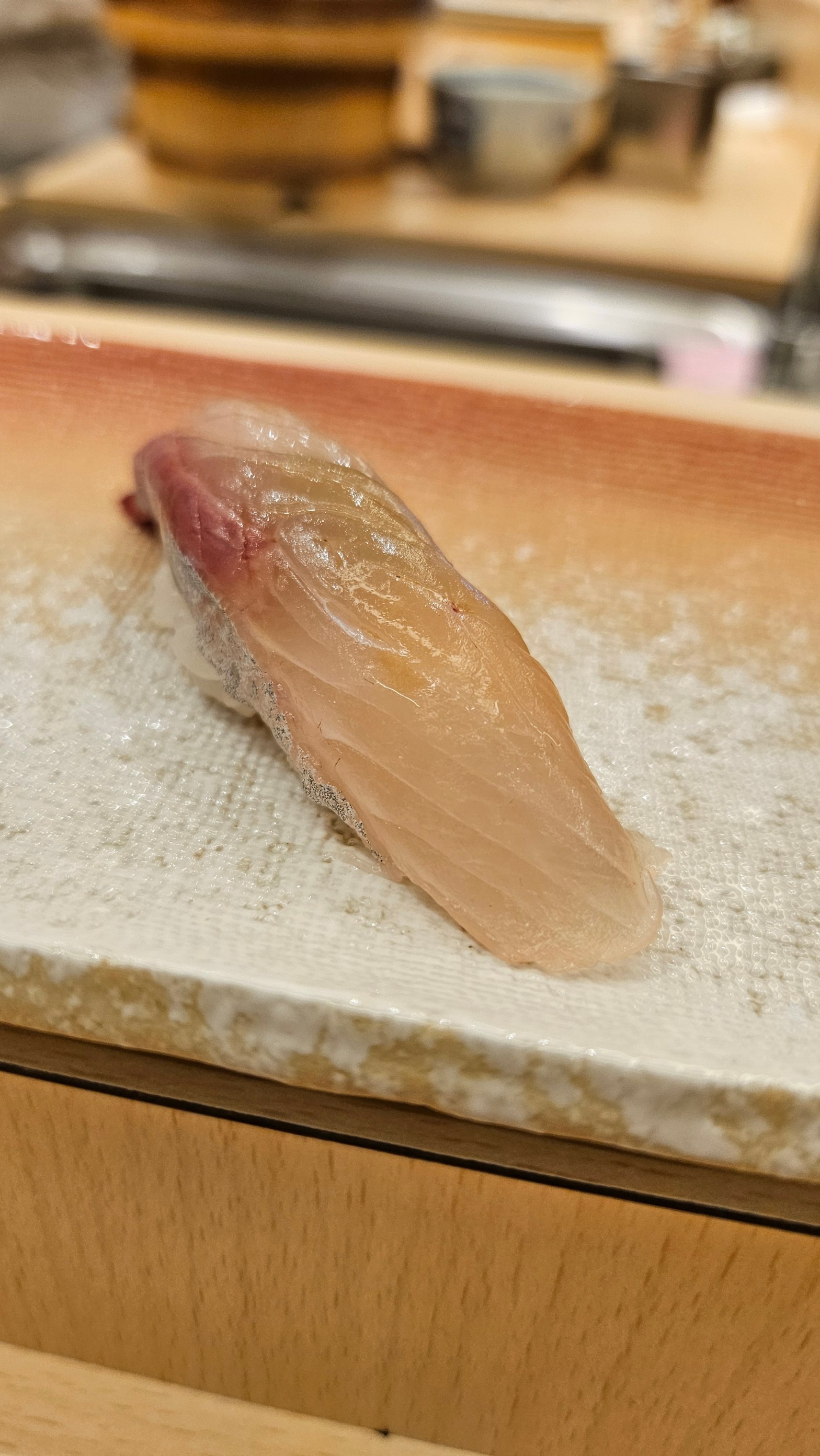
Aji is the backbone of the summer Edomae menu at Miyu, and July brings it to its absolute peak. The aji from the waters off Nagasaki and Kyushu in July is plump, well-fatted, and rich with the full flavour of the season. Its flesh is firm yet silky, with a clean brightness and natural sweetness that makes it exceptional as nigiri.
Chef Kwan serves aji in the classic Edomae style: carefully cleaned and scored, then presented as nigiri with freshly grated ginger and thinly sliced spring onion. This preparation allows the fish to speak clearly without distraction — the mark of a confident, season-aware counter.
Anago (穴子) — Sea Eel
Anago reaches its seasonal peak through June and July, making it one of the signature ingredients at the Miyu counter during this period. Unlike unagi (freshwater eel), anago is a traditional Edomae ingredient — Tokyo Bay has long been its home, and it features prominently in the Edomae canon.
The flesh of anago is lighter and more delicate than unagi, with a subtle sweetness that pairs beautifully with tsume — a reduction sauce made from the cooking juices. Chef Kwan slow-cooks anago until the flesh is tender enough to give at the slightest touch, then finishes each piece with a careful brush of tsume. Anago nigiri is a classic expression of Edomae patience and precision.
Uni (海胆) — Sea Urchin
Hokkaido uni remains extraordinary in July. The waters around Rebun Island and Rishiri, off the northern coast of Hokkaido, reach their seasonal peak in midsummer, producing the finest bafun uni and murasaki uni of the year. Bafun uni is small, intensely sweet, and golden — a concentrated expression of the sea. Murasaki uni is larger, with a more gentle and oceanic character.
At Miyu, Chef Kwan selects according to what is most expressive on that day’s delivery from Toyosu. Our signature toro-uni hand roll — toro (fatty tuna), fresh Hokkaido uni, and nori — remains one of the most anticipated courses of the summer season. It is a course built around generosity and timing.
Hatsu-ika (初烏賊) — Young Squid
Hatsu-ika — literally “first squid” — refers to young squid caught at the very beginning of their season in Japanese waters. The flesh of young squid is tender, sweet, and extraordinarily clean in flavour: quite different from mature squid caught later in the year. It is an ingredient defined by its freshness and brevity.
Prepared as nigiri, hatsu-ika is scored lightly across the surface and placed onto well-seasoned shari. No strong sauces are needed. The ingredient itself is the statement — a study in summer delicacy.
Myoga (茗荷) — Japanese Ginger
Myoga is a characteristically Japanese summer ingredient — the budding shoots of Japanese ginger, harvested before the plant flowers. It carries a mild, aromatic character: floral, slightly bitter, and refreshingly cool on the palate. It is used in Japanese cooking as a palate-cleanser and aromatic accent rather than as a primary flavour.
At Miyu, myoga appears as a seasonal garnish and accent across certain summer courses, adding aromatic brightness where it complements the primary ingredient. It is a considered, seasonal touch — the kind of detail that reflects the awareness at the heart of Chef Kwan’s cooking.
What the July 2026 Omakase Menu Looks Like at Miyu
While the menu evolves daily based on market availability, a typical July dinner omakase at Miyu might include the following courses:
- Seasonal appetiser featuring summer vegetables and a dashi preparation
- Sashimi of aji and hatsu-ika, with freshly grated wasabi from Japan
- Chawanmushi with seasonal summer garnish
- Hamo-otoshi — hamo pike conger blanched and served with umeboshi sauce
- Anago — slow-cooked, Edomae-style, finished with tsume
- Nigiri selection: aji, anago, akami, chutoro, otoro, and July specials including uni
- Toro-uni hand roll
- Tamago, clear soup, and seasonal dessert
Every ingredient is air-flown directly from Japan to Singapore. All produce arrives fresh at the Miyu kitchen in time for service. Looking back, our June 2026 omakase Singapore guide covers the early summer ingredients that open the season. Looking ahead, our August 2026 guide covers late summer at Miyu, and our September 2026 guide covers the opening of autumn. For those new to this style of dining, our guide on what is omakase explains the format, etiquette, and what to expect.
Omakase Singapore July 2026 — Reserve at Miyu
July is one of the busiest months for omakase dining in Singapore. Friday and Saturday evenings tend to fill two to three weeks in advance. We recommend booking as early as possible to secure your preferred date and sitting.
Miyu is located at 13A Dempsey Road, Singapore 247694 — a short ten-minute drive from Orchard Road and the CBD.
- Lunch omakase from $128 per person (Mon–Sun, 12pm–3pm, last order 1.30pm)
- Dinner omakase from $228 per person (Mon–Sun, 6.30pm–10.30pm, last order 8.30pm)
Reserve your table for omakase Singapore July 2026 at Miyu via our reservations page, or WhatsApp us at +65 8028 3168. We look forward to welcoming you to the Miyu counter this July.
Early July 2026: What’s at the Counter Now
As of 1 July 2026, Miyu is firmly in the heart of Japanese summer. Hamo (pike conger) is now a regular feature at the counter, aji is at absolute peak season, anago is abundant, and Hokkaido uni has reached its midsummer richness. Hatsu-ika (young squid) is appearing on the menu most evenings. Every course this month is shaped by what arrives at Toyosu Market that week, air-flown fresh to the Miyu kitchen at Dempsey Hill.
July 2026 seats at Miyu are now open and filling quickly. Friday and Saturday evenings book out two to three weeks in advance — many July weekend evenings are already close to full. If you are planning a July visit, we strongly recommend reserving as soon as possible. Reserve your July seat or WhatsApp +65 8028 3168.
Frequently Asked Questions: Omakase Singapore July 2026
July 2026 at Miyu features hamo (pike conger), aji (horse mackerel), anago (sea eel), Hokkaido uni (sea urchin), and hatsu-ika (young squid) — all at or approaching peak season, air-flown fresh from Toyosu Market weekly.
Hamo (鱧), or pike conger, is the signature ingredient of Japanese high summer, associated with Kyoto’s Gion Festival. It requires exceptional knife technique called honekiri to sever hundreds of fine bones. Chef Kwan’s mastery of this technique makes hamo one of the most distinctive courses of the July omakase at Miyu.
Lunch omakase at Miyu starts from $128 per person (Mon–Sun, 12pm–3pm). Dinner omakase starts from $228 per person (Mon–Sun, 6.30pm–10.30pm). All prices are subject to 10% service charge and prevailing GST.
Miyu is at 13A Dempsey Road, Singapore 247694 — a ten-minute drive from Orchard Road and the CBD, nestled in Dempsey Hill.
Reserve via miyu.sg/reserve/ or WhatsApp +65 8028 3168. July seatings fill quickly — we recommend booking two to three weeks in advance, particularly for weekend evenings.
3 thoughts on “July 2026 Omakase Singapore: Seasonal Japanese Ingredients at Miyu”
Comments are closed.